After the Last Dog Barks: Night Walking in the Andes With a Light Hand

Photo: Nur Alim 2001, CC BY-SA 4.0, via Wikimedia Commons
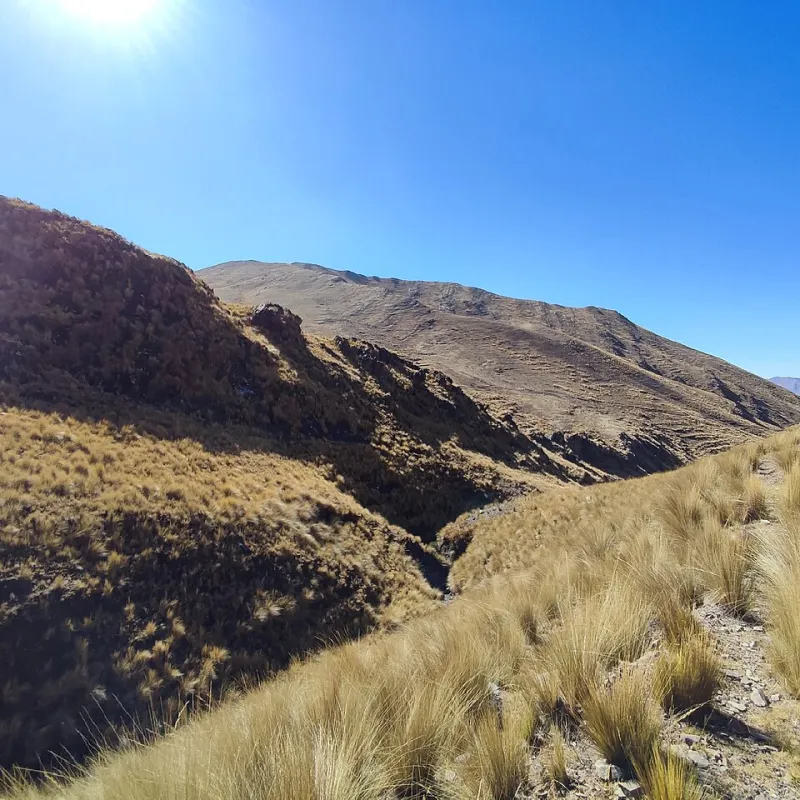
In the US, we tend to treat a headlamp like proof of preparedness. It clips to the pack, it has a red mode, it makes us feel like we have the situation handled. In an Andean village at 4 a.m., a beam swung across a window is not proof of anything except that someone is awake and possibly annoyed. Night travel here is completely doable — many trail days start before dawn — but it works best when you plan around the moon, the village, and the dogs rather than around the brightest setting on your lamp.
Start With the Calendar, Not the Gear
Before you worry about lumens, look at the moon. A full moon near the date of your walk gives you real shape: ridgelines, trail edges, the pale line of a stream crossing. A new moon gives you stars and very little else. Both are useful, but they ask for different plans.
For a first night walk or an unfamiliar pre-dawn start, I like the few days around a waxing or waning gibbous moon. You get enough light to read the trail without turning the valley into a stage. Around the new moon, save the night miles for trails you already know or routes with a clear, broad path. And check moonrise and moonset, not just the phase. A bright moon that sets at 2 a.m. leaves you walking into a very dark second half.
This is not about being mystical. It is about arriving at the trailhead with a realistic idea of what you will be able to see. A full moon is not daylight. It flattens depth, hides rocks in shadow, and makes every distant light look closer than it is. Plan to move slower than you would in the day, especially on scree, mud, or anything with a drop beside it.
What the Southern Sky Can Actually Tell You
You do not need to become an astronomer to use the night sky, but a little orientation helps. In the southern hemisphere, the Southern Cross and its two pointer stars can give you a rough south. The Magellanic Clouds are useful landmarks when they are visible. The Milky Way can be bright enough to silhouette a ridge.
Use these as confirmation, not navigation. Stars wheel through the night. A bearing you took at 9 p.m. may feel wrong at midnight if you have been turning on switchbacks. Keep a paper map and compass handy, and carry a GPS or phone with offline maps as backup. Do not count on a screen to replace looking at the ground. On night trails, the most important beta is usually local: where the path widens, where the irrigation channel crosses, where the dogs live.
Village Lights Are Both Map and Message
From above, a village at night looks like a handful of embers. Those lights tell you where people are sleeping, where the road bends, and which side of the valley you are on. They are also a boundary.
Stay on the trail as it passes houses. Do not cut through a yard because the light makes it look like a shortcut. If a window glows, resist the urge to look in. A headlamp pointed at a house is a knock without a door, and at that hour it is not a welcome one. Keep your beam low and pointed at the ground a few steps ahead, or turn it off entirely and let the moon do the work. Your eyes will adjust more than you expect.
In villages, darkness is not empty. People get up early. Animals are penned close. A light sweeping across a corral can set off a mule, a pig, or every dog in earshot. Think of your beam as a conversation starter you probably do not want to start.
The Headlamp Has a Volume Knob
A headlamp is useful. It is also the fastest way to turn a quiet trail into a light show. Use the lowest setting that lets you see the next few feet. Red mode is kinder to night vision and less visible from a distance, but it is not invisible. Cup your hand over the lens when you need to check a map near a house. Point the light down, not out.
When you meet someone on the trail after dark, drop the beam to the ground and say good evening. Do not illuminate their face. If you are walking with a group, resist the urge to light up the whole valley so everyone can see each other. One low beam at the front and one at the back is usually enough. The rest of us can manage.
Dogs, Gates, and Other Night Ambassadors
Dogs are the real night auditors of Andean trails. They hear you before they see you, and a bright beam makes you more interesting, not less. If a dog starts barking, stop. Keep your light low or off. Speak quietly. Wait for the dog to settle or for someone to call it off. Do not run, and do not swing the beam around trying to find the source.
Gates matter too. A closed gate at night is closed for a reason. Climb it only if you are certain it is the trail and you can close it exactly as you found it. If a dog is telling the whole valley that you are there, you have already lost the quiet contest. The best move is often to back up, take the long way, or wait for first light.
Safety Notes for Independent Hikers
Night walking is not the place for improvisation. Tell your lodging or a guide where you are going and when you expect to be back. Carry a backup light and spare batteries. Wear more layers than you think you need; Andean nights drain heat fast once you stop moving. Keep water and snacks accessible, not buried in the pack.
Give yourself a firm turnaround time. Stream crossings are harder to read in the dark. Cairns disappear into shadow. A route that felt obvious at noon can look like a suggestion at 3 a.m. If you are not sure of the trail, stop and wait for dawn. The mountain is not going anywhere, and neither is the bus, usually.
Pre-Dawn Starts Without the 4 A.M. Theater
If you are leaving before dawn, pack the night before. Lay out layers, fill your water, and know where your lamp is without digging. Leave from the edge of town rather than the middle of it. Close doors quietly. Do not idle a car outside a guesthouse. Do not play music. A pre-dawn start should be boring for everyone else.
And know when to skip it. Heavy cloud, rain, an unfamiliar route, a moonless night, or a tired group are all good reasons to wait. The best night walk is the one that does not wake the village, upset the dogs, or require a rescue. The moon can be your headlamp. Just do not make it everyone else's problem.