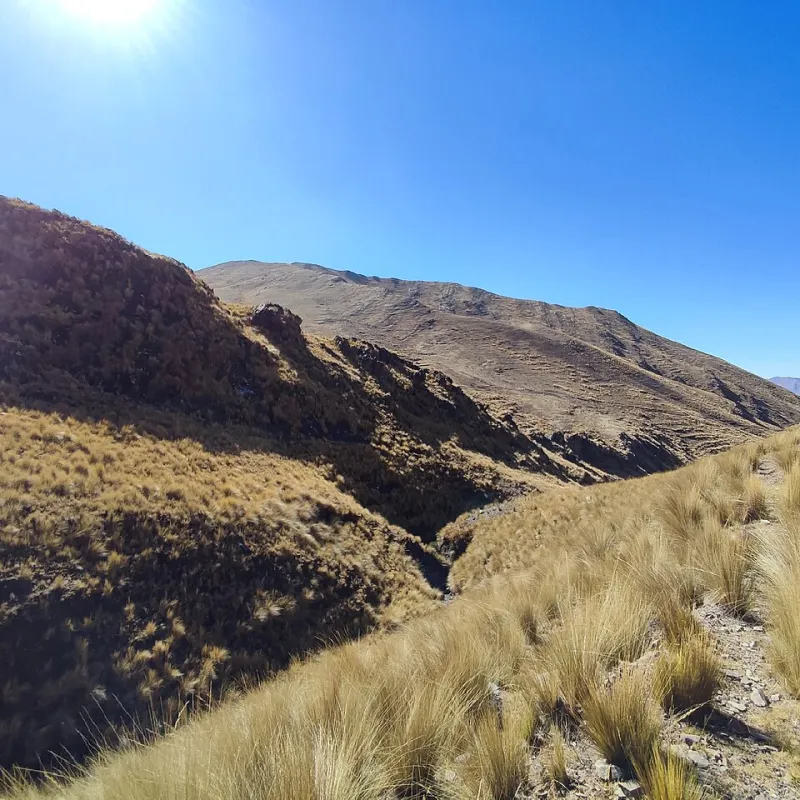
Gravity Is the Hard Part: A Field Guide to Coming Down Andean Trails

Photo by Photo by Hanna Lazar on Unsplash on Unsplash
Standing on a 15,000-foot pass, most people are thinking about the view. A smaller and wiser group is thinking about the four hours of walking between them and dinner. That second group tends to finish the day without a story about a knee.
The summit is the easy sell
Every photo in every guidebook is taken at the top, so the top gets all the planning. The uphill is hard in an honest way: it is slow, it is obvious, and your body files a report with every step. The downhill is hard in a dishonest way. It shows up when you are already tired, when your guard is down, and when the reward feels close enough to hurry toward. That is precisely the moment the mountain collects.
Why the way down costs more
Three things are working against you, and only one of them is gravity. The first is eccentric loading: your quadriceps lengthening under tension, step after step, which is the same mechanism that leaves skiers hobbling the day after a long descent. The second is impact, since a downhill step can load the knee with several times your body weight and on loose ground that force often arrives slightly sideways. The third is fatigue, which quietly degrades your balance and your foot's ability to report what it just landed on.
Andean trails add their own variables. Scree that looks stable until it isn't. Mud that has a crust and nothing underneath. Stone steps laid out for a mule's stride rather than yours, which means roughly two of your steps per step, or one long lunge you will regret by Thursday.
Short steps, quiet feet
The biggest single improvement in downhill safety is almost embarrassingly boring: take smaller steps. Most hikers lengthen their stride on the way down because it feels efficient and because the trail is pulling them. It isn't efficient. It is a controlled fall you are calling walking.
Try walking so that your boots make almost no sound. If you can hear the slap, you are dropping your weight onto the joint instead of arriving with it. Think about placing the foot rather than catching yourself on it, and keep your hips over your feet instead of trailing behind them.
Reading the ground you're on
- Scree. Land heel-first, keep steps short, and aim for the edges of the slope where the particles are more consolidated. Traversing across a scree field beats plunging straight down it.
- Rock steps. Use your hands on the uphill side. There is no prize for staying upright without touching anything.
- Mud. Poke it with a pole before you commit. Shiny mud is usually deeper than matte mud.
- Gravel over hardpan. This is the highest-slip surface in the Andes and it looks completely fine. Shorten everything and slow down before you enter it, not after.
Poles are not a fashion decision
If you carry poles, shorten them for the descent, usually by a few inches compared to your uphill setting. Longer poles on a downhill walk push your weight back and make you lean away from the slope, which is the opposite of stable. Plant the pole before you transfer weight, let it swing naturally, and skip the death grip. If you only carry one pole, put it on the side of the knee that complains more.
The turnaround math nobody does
Here is the calculation worth doing at breakfast: assume the descent takes 60 to 70 percent of your ascent time, and then add time for altitude, heat, and the fact that you will be tired. Most people budget 50 percent and then improvise. If you are descending and find yourself taking more than a couple of unplanned sit-downs per hour, that is data, not weakness. Slow down or cut the route.
A related note: a lot of Andean descents end at a village where the last transport leaves early. Build that into the plan before you leave, not while you are watching taillights disappear.
When it does go wrong
If a knee starts giving way rather than just aching, stop treating the trail as a race. Pull the pole length in, shorten the stride further, and let the strongest person in the group take the heavy pack. If someone truly cannot weight the leg, a mule or a vehicle is not a failure of character, and local families are usually the fastest route to both.
A short pre-descent checklist
Before you leave the pass: eat something, drink something, adjust pole length, tighten your laces slightly for the descent, and name the time you expect to be down out loud. It sounds fussy. It also takes ninety seconds and has saved a lot of people a very long afternoon.
The summit gets the photograph. The descent is what decides whether you enjoyed the trip.