Learning the Loom: How to Tell a Real Weaving Workshop From a Photo Op
The first weaving "workshop" I signed up for in the Andes lasted 45 minutes. Twenty of those were spent on a bench watching a dye pot, ten on a sales pitch delivered with real charm, and fifteen in a room full of table runners. I bought a belt. I learned nothing.
The second one took four days. I finished a piece roughly the size of a placemat, badly, and I understood for the first time how much of a human life fits into a single textile. If you are going to spend money on craft travel, that is the difference worth paying for.
Demo, Class, or Apprenticeship
Most travelers encounter three tiers, and they are not interchangeable.
The demonstration is short, cheap or free, and exists to move product. That is fine — some of those sales rooms support real cooperatives — but it is not learning.
The half-day class usually covers natural dyeing plus the basics of setting up a backstrap loom. You leave with a small band or bracelet and a vague sense of how tension works. Good value, low commitment.
The multi-day workshop is where the actual skill lives. You warp, spin, dye, weave, and fix your own mistakes. Expect three to five days for a small piece; a full lliclla or a carrying cloth is weeks or months of work, which is exactly the point.
What the Loom Asks of You
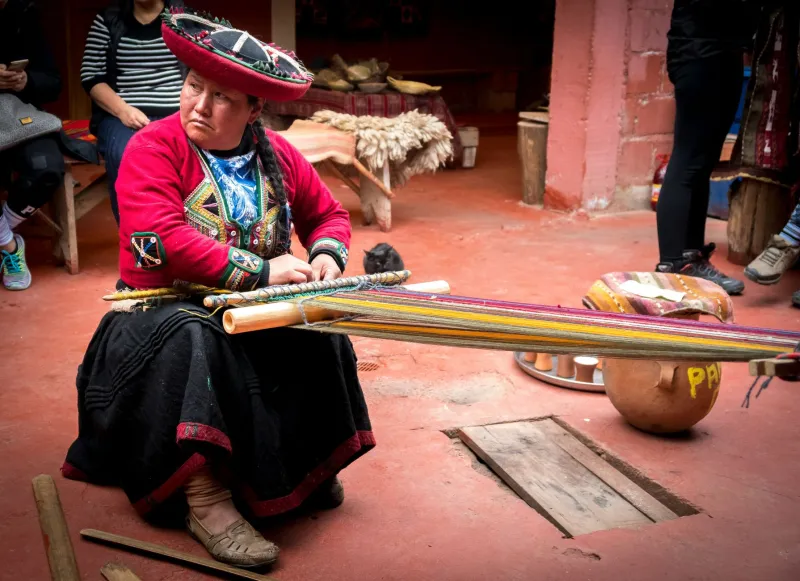
A backstrap loom gets its tension from your body. You sit on the ground, loop the strap around your hips, and lean back. Your spine becomes part of the equipment. First-timers are always surprised by how physical it is and how slowly the fabric grows — a few inches in a good afternoon.
The teachers are patient about this. They have watched a lot of foreigners discover that their hands are not as clever as they assumed.
Three Cooperatives Worth the Detour
Centro de Textiles Tradicionales del Cusco (CTTC). Founded in the 1990s to keep Cusqueñan weaving traditions alive and pay weavers properly, the CTTC works with groups in several communities and runs classes in Cusco. The shop labels pieces with the maker's name and community, which is rarer than it should be.
The Chinchero weavers. Chinchero, about 40 minutes outside Cusco, has a well-established cooperative affiliated with the CTTC. Half-day programs cover natural dyeing with cochineal, q'olle, and other plants, plus loom time. It is popular, so book ahead and confirm whether you are getting a class or a demo before you pay.
ASUR and the Museo de Arte Indígena in Sucre, Bolivia. The Jalq'a and Tarabuco weaving traditions are among the most distinctive in the Andes, and ASUR's work in Chuquisaca supports weavers who are paid per piece. The museum gives you the context — iconography, regional styles, how designs are owned — that makes the workshop mean something. Arrangements change, so write ahead and ask in Spanish if you can.
The Math of a Fair Price
A fair workshop price covers more than the hours you sit there. It covers fiber (wool or alpaca, carded and spun by hand), dye plants and mordants, the teacher's time preparing materials before you arrived, an interpreter if needed, meals, and a contribution to the cooperative.
In 2026, somewhere around $120 to $200 per person per day for a genuine multi-day workshop is not unreasonable. A 45-minute demonstration priced at $35 is theater with a gift shop attached.
Two warnings. First, "free" demonstrations where the real transaction happens in the shop — ask directly what the weaver earns from the class itself. Second, workshops where the teacher is paid per tourist rather than per hour or per day. That structure rewards volume, not teaching.
Etiquette That Is Not Optional
- Ask before photographing designs, looms, or the person weaving. Some patterns are family or community property.
- Do not haggle with the person who just taught you. Haggle in the market if you must; pay the teacher what the class costs.
- Understand that not every design is for sale, and not every motif is yours to reproduce and sell at home.
- Buy your materials from the cooperative, not from a cheaper stall across town.
- Learn five words of Quechua or Aymara: hello, thank you, how much, beautiful, goodbye. The effort lands.
- Put the phone down and finish the piece you started, even if it is crooked.
- If an interpreter is needed, pay for them separately rather than letting the teacher absorb the cost.
Five Questions to Vet a Workshop
- Who teaches, and how are they paid — per student, per class, or per day?
- How many hours of actual loom time do I get each day?
- What will I finish, and can I take it home?
- Where do the fiber and dyes come from?
- Can I buy directly from the makers, and does that money go to them?
Ask by email before you arrive, and read the answer for specificity rather than enthusiasm.
Skills Beat Souvenirs
My bad placemat is on a shelf in my apartment in Colorado, next to nothing valuable. It is the only thing I own from Peru that I can honestly say I made, and it is the reason I now look at a market stall full of belts and think about hours instead of prices.
You do not need to become a weaver. You need one afternoon, or better one week, of understanding that a textile is labor before it is a souvenir. That understanding is what changes how you pay, and who you pay.